
What is SWIR?
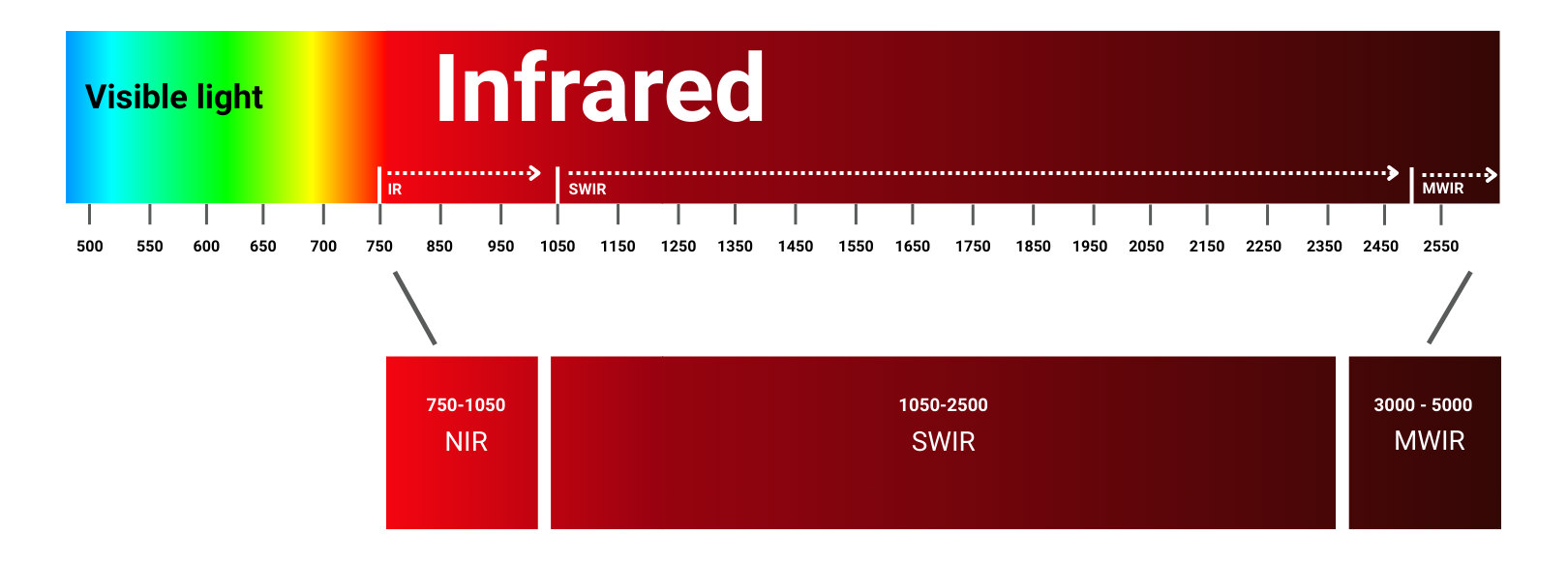
Short Wave Infrared (SWIR) is a segment of the electromagnetic spectrum, located between visible light and long-wave infrared; SWIR typically lies between 1050nm to 2500nm. These wavelengths are invisible to the human eye but can be extremely useful to advanced imaging.
To optimally capture SWIR radiation, specialised SWIR cameras are designed with either indium gallium arsenide (inGaAs) sensors or mercury cadmium telluride (MCT) sensors, enabling high-quality imaging for detailed inspections. InGaAs and MCT contain optical and electronic components which allow the camera to operate in the specific SWIR range.
On standard machine vision cameras, silicon sensors are used, these typically operate up to 900nm – 1000nm, with sensitivity dropping rapidly above this range.
SWIR Machine Vision Systems
Specialised machine vision components that are optimised for short-wave infrared, are essential for high-performance imaging. By providing superior contrast, material penetration, and moisture detection, this technology is particularly effective for complex applications such as inspection, sorting, and quality control. It reveals details invisible to the human eye while maintaining high-resolution, monochromatic imagery.
When paired together, SWIR cameras and SWIR lighting bridge the gap between visible light and long-wave infrared to deliver unmatched precision in industrial processing.
SWIR lighting is the main driver in creating contrast in non-visible imaging by targeting specific chemical signatures of materials. It generates the narrowband wavelengths needed to highlight target features. Modern systems use SWIR LED lights to produce high-intensity illumination that can be strobed to freeze motion on high speed production lines.
Available in different forms like ring lights for uniform surface illumination, bar lights for area inspections, and dome lights to eliminate glare on reflective surfaces.
Key SWIR Wavelengths & Applications
- 1050nm to 1200nm : Regularly used for semiconductor inspection because silicon turns transparent at these wavelengths, allowing cameras to see through wafers to look for internal cracks or alignment cracks.
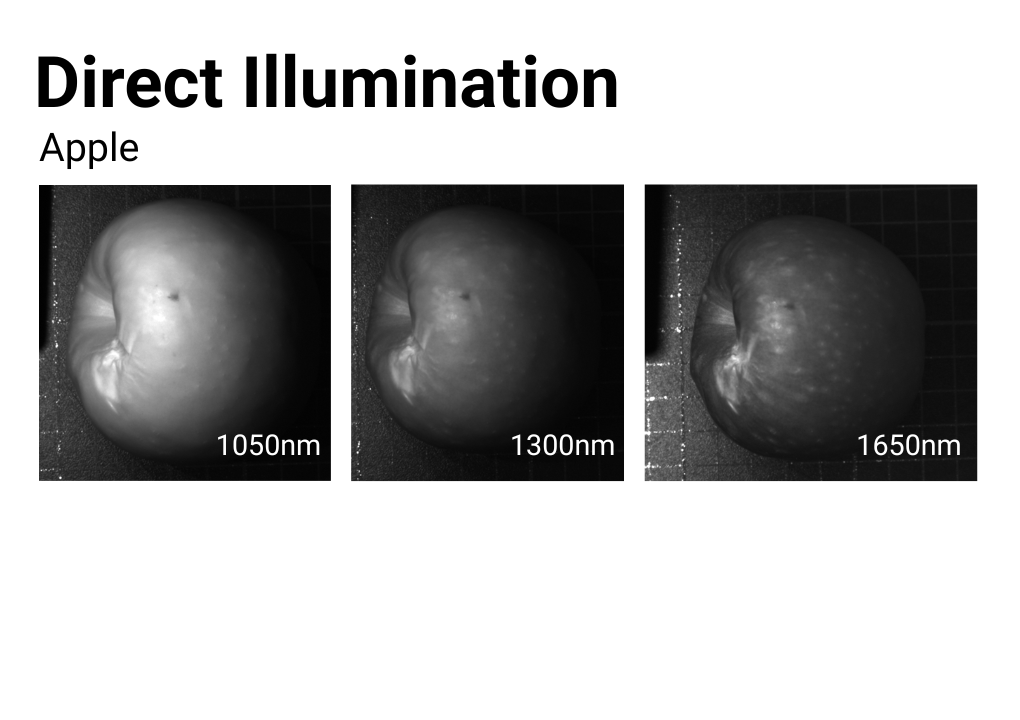
- 1450nm to 1550nm: These wavelengths are used for identifying moisture in objects making them appear jet black against a bright background. For example, a bruise inside an apple, a fill line in a plastic bottle, or a leak in a package.
- 1650nm and above: Used for material sorting, particularly in recycling, to distinguish between different types of plastics and highlight characteristics that would be hidden at higher infrared bands.
Advantages of SWIR Technology
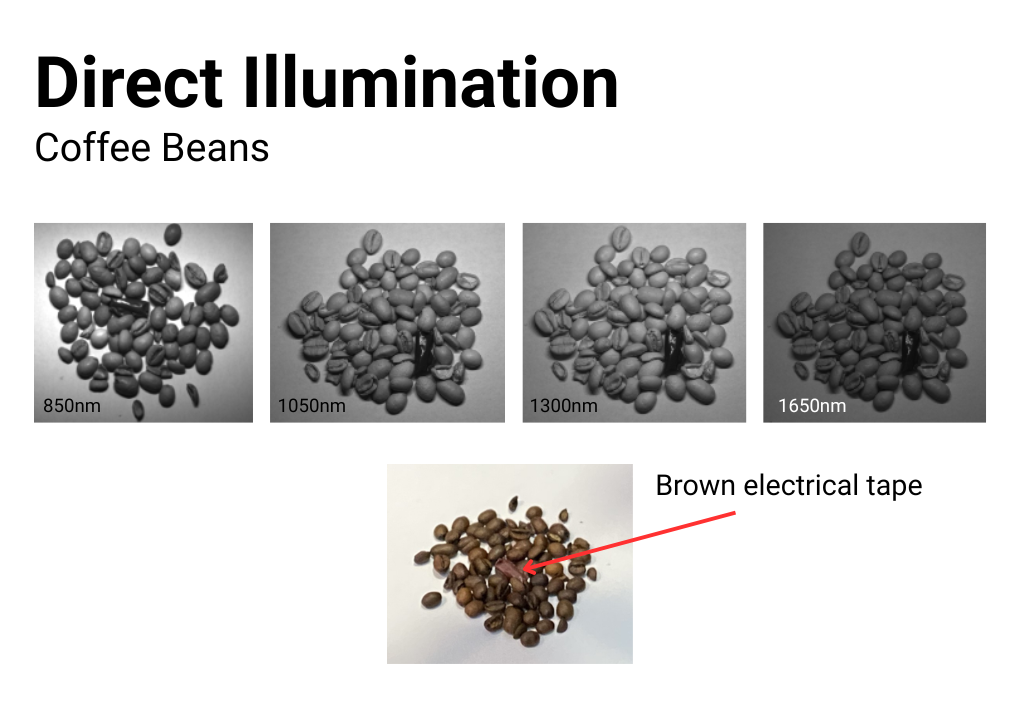
SWIR technology is particularly beneficial in its ability to reveal ‘invisible’ physical characteristics without damaging the object or material. The same object can look completely different under SWIR than in regular visible light. While a SWIR camera acts as the key observer, using an InGaAs sensor to detect light in the 900nm – 1700nm range, the SWIR lighting is what truly creates the suitable contrast.
The main advantages of using SWIR lighting are:
- Material Differentiation: SWIR light allows you to see chemical differences and it allows you to see moisture in objects as super black.
- High-Intensity Precision: By providing narrowband illumination, LED SWIR lights ensure you are only hitting the target with the exact wavelength needed for the application, reducing heat and improving the signal-to-noise ratio for the camera.
- Strobing Capabilities: Industrial SWIR LEDs can be operated in OverDrive and Strobe mode using controllers. For high-speed machine vision lines, this is a great advantage as it allows users to freeze motion and provides extreme brightness that is required for short exposure times.
- Environmental Transparency: SWIR wavelengths can penetrate certain obscurants. Dedicated SWIR ring lights can illuminate targets through heavy smoke, haze, or even certain plastics and silicon, allowing for ‘see-through’ inspection of packaged goods or semiconductor wafers.
SWIR Integration Strategy: Strobing and Thermal Management
Unlike standard LEDs, SWIR LEDs produce more heat. This high heat can potentially shift the wavelength slightly or cast dark current, adding noise into the camera. It is best practice to use strobe power which enables users to “pulse” the SWIR light only when the camera shutter is open. This allows you to OverDrive the LEDs for much higher brightness on fast-moving production lines without overheating the hardware.
By unveiling invisible material characteristics through extreme contrast and precise moisture detection, SWIR technology has become a transformative force in advanced imaging. Its ability to resolve complex challenges makes it indispensable for the future industrial inspection, sorting and quality control.
Contact Us for Customised SWIR Lighting
TPL Vision offer custom SWIR products tailored to your unique application requirements.
Our in-house team can help you find the most efficient solution. We’ll support you through every step of the process with an experienced project management & engineering team to solve the most complex imaging challenges.