
High-speed inspection environments rely on precise and adaptable illumination to maintain consistent image quality across varying product types and production conditions. As inspection systems scale across multiple stations, lighting control becomes increasingly complex, particularly where different stages require different optical configurations and tight synchronisation with imaging systems.
In addition, growing system size often introduces increased wiring demands and more complex setup and configuration processes, making commissioning and future modification more time-consuming.
To address these challenges, this application uses the TPL-CONTROL-1, an external Ethernet and RS232-controllable controller designed to centralise control and enable scalable management of multiple machine vision lights within a single system architecture. The controller accepts a compact ASCII command set over both interfaces, so intensity, trigger timing, and operating mode can be changed directly from a PLC, vision system, or terminal, without dedicated software.
Challenges in the Machine Vision Market
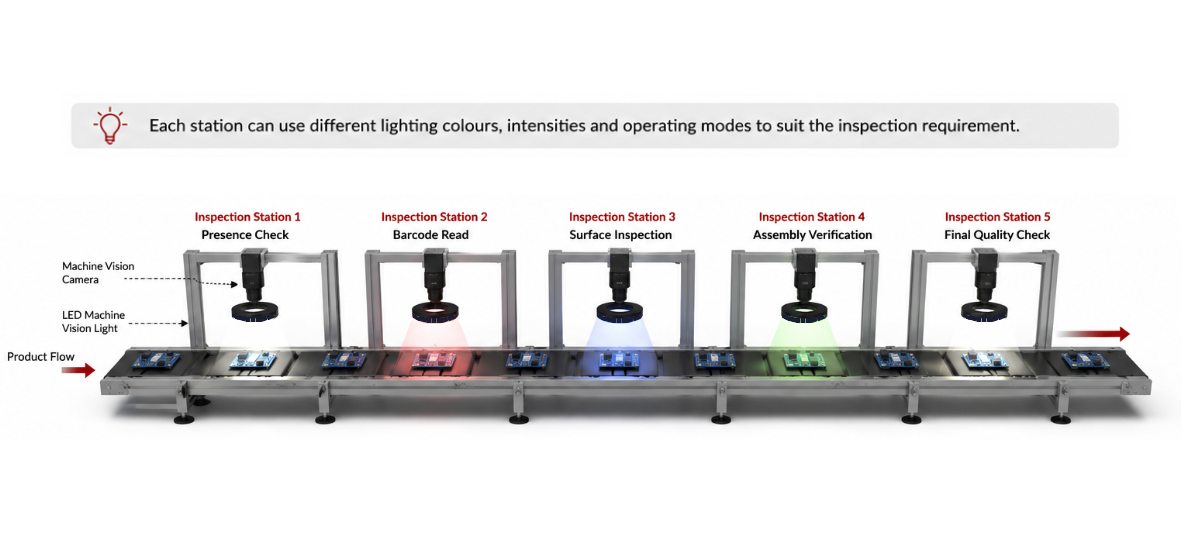
- Challenge 1 – Multiple inspection points with varying lighting requirements: A high-volume production line inspects products of different shapes, sizes, surfaces, and materials. Each stage of production may require different lighting colours, intensities, or operating modes, making it difficult to manage multiple independent lighting systems efficiently.
- Challenge 2 – Precise synchronisation between lighting, cameras, and triggers: Reliable machine vision depends on accurate timing between illumination and image capture. As the number of cameras and inspection stations increases, maintaining precise synchronisation becomes more challenging. Poorly coordinated triggering can result in inconsistent images, reduced inspection accuracy, and lower production efficiency.
- Challenge 3 – Reduced wiring complexity and faster configuration: Large-scale inspection systems can require significant wiring and lengthy setup times. Complex installations take up time, making reconfiguration more difficult, and systems can be less optimised when production requirements change.
Traditional setups rely on:
- Individual controllers per light
- Limited visibility into system performance
- Difficult diagnostics and scaling issues
Solutions
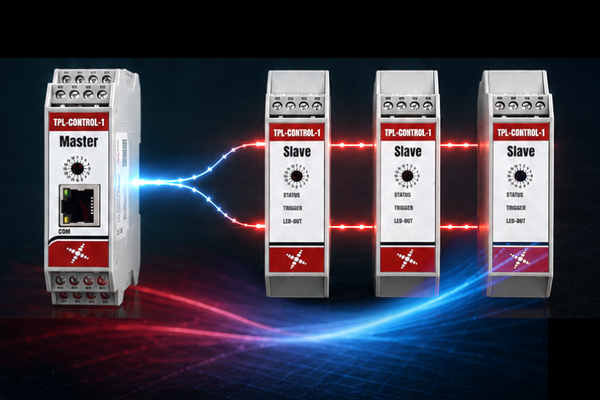
The TPL-CONTROL-1 is used as a central Ethernet-based controller for up to 16 machine vision lights across the production line. It functions as a dedicated strobe controller for LED lights, enabling precise pulsed illumination and synchronisation with high-speed imaging applications. It provides a single point of configuration and control, enabling consistent management of all connected lighting channels.
- Solution 1 – Centralised Ethernet and RS232 command control
All lighting channels are configured and managed through the TPL-CONTROL-1 via an Ethernet controller. This allows individual lights to be assigned specific operating parameters such as colour, intensity, and mode, without the need for separate controllers at each station. Since the RS232 and Ethernet share the same simple ASCII command structure, the same commands integrate a light into a PLC ladder program, a test script, or a vision system’s I/O sequence with no protocol translation required. Brightness on any channel, for example, is set with a single short command specifying the channel and the target percentage, and the controller confirms the change immediately, so operators can verify and adjust brightness in real time rather than waiting on a manufacturer-specific configuration tool.
- Solution 2 – Independent channel control with precise triggering
Each lighting output can be independently configured for intensity, pulse timing, and trigger response. External trigger inputs allow precise synchronisation between illumination and camera capture, ensuring consistent image acquisition across all inspection points.
- Solution 3 – Modular and scalable architecture
The system is designed to support flexible expansion, allowing compatible lights to be added, removed, or replaced without system redesign. This reduces wiring complexity and simplifies reconfiguration as production requirements evolve.
How the TPL-CONTROL-1 Delivers Intelligent Lighting Control
The TPL-CONTROL-1 combines lighting control with continuous system monitoring. Commands are sent from the controller to each connected light, while operational and diagnostic information is returned in real time. This two-way communication gives operators complete visibility of the lighting system, making commissioning, monitoring and maintenance significantly easier. The same command set is used whether the controller is addressed over RS232 or Ethernet, making it easy to upgrade from RS232 to Ethernet without changing the way the system is controlled.
Controller -> Light
- Set intensity (0-100% per channel, in 1% steps)
- Configure trigger timing (pulse width and delay set in microseconds per channel, for tight synchronisation with camera exposure)
- Select operating mode
- Update control parameters
Light -> Controller
- Report operating voltage
- Return status information
- Provide diagnostic and stability data
This continuous feedback helps ensure every light is performing correctly, allowing faults to be detected quickly and helping maintain consistent inspection performance across the production line.
Results and Benefits
- Improved process reliability through continuous monitoring
Real-time status and diagnostic feedback from each light allows ongoing monitoring of system performance. This helps detect issues early, reducing downtime and ensuring consistent illumination for machine vision inspection.
- Faster commissioning and simplified setup
Centralised Ethernet control allows all lighting channels to be configured from a single interface. This reduces installation time and simplifies commissioning compared to individual light configuration. Since the RS232 is also supported using the same command set, integrators can commission and test channels from a laptop terminal before the line’s Ethernet network is available, then hand control to the PLC or vision system once installation is complete.
- Easier fault detection and faster maintenance
Channel-level feedback makes it easier to identify issues such as voltage deviations or abnormal operating behaviour. This speeds up troubleshooting and reduces production interruptions.
- Scalable architecture for future expansion
The modular design of the TPL-CONTROL-1 allows additional lights and inspection points to be added without redesigning the system, supporting easy expansion as production needs evolve.