How to Set Up Lighting for Inkjet Inspection

What is Inkjet Marking?

Inkjet marking is a non-contact industrial printing technology that sprays drops of ink to create high-quality text, codes, barcodes and logos. These fully automated solutions can easily be applied to almost any product with surfaces like plastics, metals, and glass even if their shape is regular or irregular. This is highly cost-effective and used across many industries to deliver accurate markings in real-time for product identification and traceability purposes.

How Machine Vision Improves Inkjet Code Inspections

Machine vision systems are commonly used to perform optical character recognition (OCR) and optical character verification (OCV) on inkjet markings. OCR reads and converts printed text into digital data, while OCV confirms if the printed characters are present, correct, and legible. By combining high-resolution vision cameras with precision lighting, manufacturers can maintain consistent quality control, 

improve traceability, and verify marking accuracy throughout the production process. Together, inkjet printing and machine vision create a controlled identification, verification, and traceability system for production lines where the printer applies the code and the vision system confirms it has been printed correctly.

Machine Vision Workflow for Inkjet Inspections:

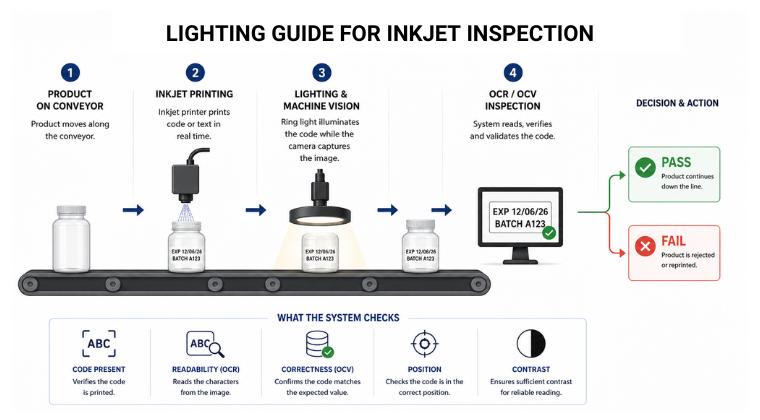
Step 1. Product moves along the conveyor

Step 2. The inkjet system prints code/text in real time 

Step 3. A machine vision system immediately checks:

  • Is the code present?
  • Is it readable (OCR/OCV)?
  • Is it correct (matches database)?
  • Is it positioned correctly?
  • Is contrast sufficient?

If anything is wrong here, the system triggers a reject or reprint

Process for inkjet inspections using machine vision inspection systems

WHY DOES LIGHTING MATTER IN INKJET CODE INSPECTION?

Lighting plays a critical role in inkjet code inspection because it directly affects how clearly and consistently a machine vision system can capture and verify printed characters for OCR and OCV applications.

Relying solely on the integrated lighting within a vision camera can make inspections more difficult, particularly when dealing with reflective packaging, curved surfaces, low-contrast codes, or inconsistent print quality.

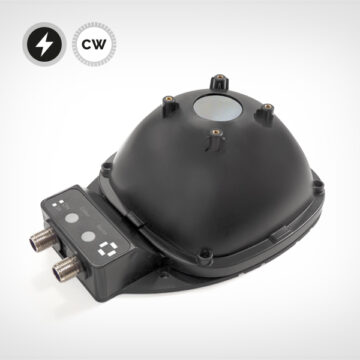
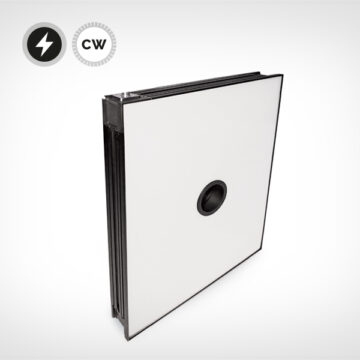
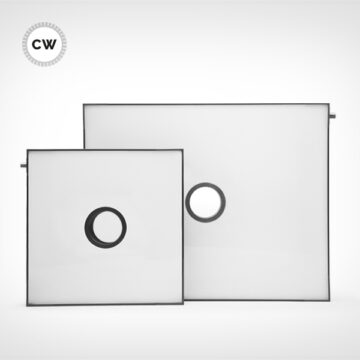
For most inkjet marking inspections, diffused LED lighting is typically the preferred solution because it reduces glare, softens reflections, and creates even illumination across the inspection area. This improves contrast between the printed code and the material, allowing the camera to capture clearer, more consistent images for accurate character recognition and verification.

Precision diffused lighting also helps minimise shadows and hotspots, enabling faster inspections, improved read rates, and more reliable detection of missing, blurred, or incorrect characters.

Comparison of Lighting Types:

  • Diffused dome lighting (best for reflections)
  • Backlighting (best for silhouette/contrast checks)
  • Dark-field lighting (best for surface defects and embossing)
  • Direct lighting (high intensity, but more glare risk)

Improving Inkjet Print Quality with Machine Vision

Inkjet printing can be complicated due to:

  • Ink spreading on different surfaces/materials
  • Surfaces can be highly reflective (metal, plastic, glass)
  • Speed of production lines
  • Environmental effects (dust, vibration)

Machine Vision solves this by:

  • Confirming print quality in real time
  • Detecting missing or misprinted characters
  • Validating codes for traceability systems

Inkjet Inspection Applications

Food & Beverage: Expiry Date and Batch Code Verification

In food and beverage manufacturing, machine vision systems inspect expiry dates, batch numbers, and production codes to ensure they are clearly printed and readable before products leave the line. Reliable OCR and OCV inspections help manufacturers maintain traceability, reduce labelling errors, and support compliance with food safety regulations.

Pharmaceuticals: Product Identification and Compliance

Pharmaceutical production requires highly accurate code verification to support patient safety and regulatory compliance. Machine vision systems inspect lot numbers, serial numbers, and expiry dates on packaging, labels, and blister packs to confirm that all information is present, legible, and correctly printed. This helps prevent mislabelling and supports full product traceability throughout the supply chain.

Automotive and Electronics: Serialisation and Traceability

In automotive and electronics manufacturing, inkjet marking inspections are commonly used to verify serial numbers, PCB markings, barcodes, and traceability codes on components and assemblies. Machine vision enables fast, non-contact inspection of high-speed production lines, ensuring every part can be identified and traced throughout manufacturing, testing, and distribution.

Inkjet marking combined with machine vision inspection provides a highly reliable and efficient solution for modern manufacturing traceability. Well-designed, diffused LED illumination enables machine vision systems to overcome common challenges such as reflections, surface variations, and low-contrast prints. This ensures stable inspections even at high production speeds and across diverse materials. As a result, industries such as food and beverage, pharmaceuticals, automotive, and electronics can maintain compliance, reduce errors, and strengthen end-to-end product traceability.

Ultimately, inkjet marking and machine vision together transform simple product coding into a fully verified digital identity system for manufacturing.

Related products

  • mr dark field (dkf)

    MR-Dark Field (DKF)

    • Dark field light
    • OverDrive, sectors, bicolour
    • 80mm and 130mm IntØ
  • mr dome

    MR-Dome

    • Powerful dome light
    • Overdrive, sectors, bicolour
    • 80mm and 130mm IntØ
  • medium mfdome+ overdrive

    Medium MFDOME+ OverDrive

    • OverDrive strobe flat dome
    • Dimming via potentiometer
    • Sizes from 0.04m² to 0. 81m²
  • high power hpfdome

    High Power HPFDOME

    • Powerful, easy to use flat dome
    • Tiny 4mm borders
    • Sizes from 0.04m² to 0.81m²